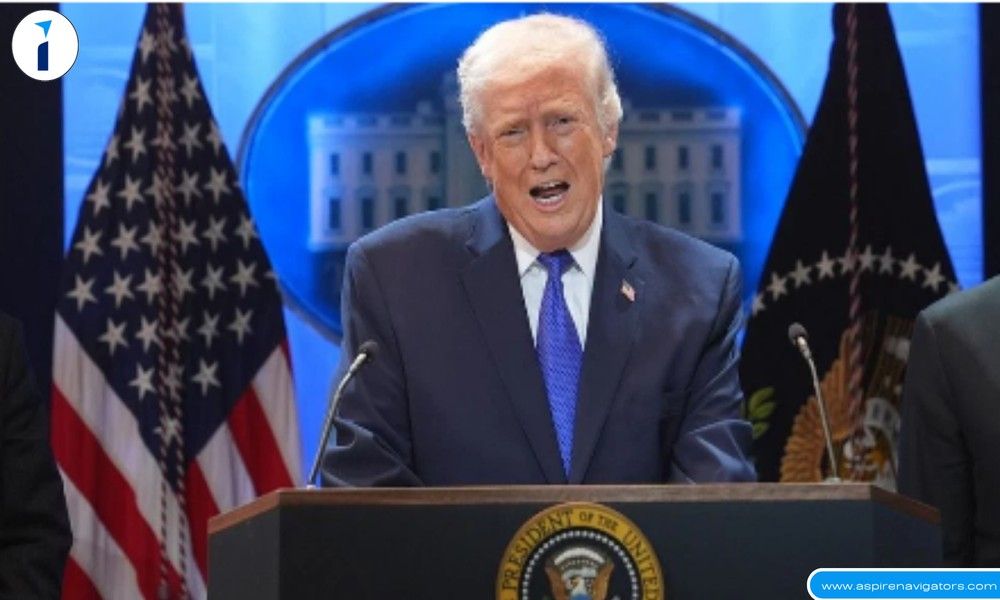
A federal appeals court has temporarily halted the decision against Trump’s 10% global tariff, which is an unexpected event in U.S. trade policy. Businesses and global markets that are already managing difficult trade tensions are now unclear as a result of this move. Although the tariff’s original goal was to safeguard American businesses, its wider economic ramifications have generated debate in both political and business circles.
As the courts consider the boundaries of presidential power, the action also draws attention to the ongoing discussion about executive authority in determining trade policy. The ruling pause is both a relief for importers and exporters and a warning that significant trade disruptions may still be imminent.
The Court Case Regarding Trump’s Tariff Proceeds
Businesses and trade associations have filed legal objections to the 10% duty, which impacts a variety of imported items, claiming it goes beyond the president’s jurisdiction. In essence, enforcement is put on hold by the appeals court’s order to postpone the lower court’s decision, enabling the tariff to stay in place for a while.
Important things to comprehend:
All imported goods are subject to the levy, which has an impact on everything from electronics to cars.
Critics contend that it would result in trade partner retribution and increased prices for American consumers.
Proponents contend that it boosts domestic industry and safeguards American industrial employment.
Experts advise businesses to be cautious and prepare for both scenarios—tariffs in place or lifted—while the legal procedure is ongoing.
Economic and Global Trade Implications
The court ruling’s pause sends shockwaves through international markets: analysts caution that international supply chains may face uncertainty, especially for nations that rely heavily on exports to the United States; trade partners may reevaluate their strategies in light of the uncertainty; and potential strain in U.S.-China and U.S.-EU trade relations. The situation also ties into broader geopolitical strategies, particularly Trump’s promise of a 100% tariff for nations that reject the dollar, which, while still speculative, shows a willingness to use trade policy as a tool of economic influence.
Global markets are affected by the court ruling’s suspension. International supply chains may encounter uncertainty, according to analysts, especially for nations that depend significantly on exports to the United States. The consequences include:
Possible price hikes for items imported into the United States Given the uncertainty, partners can reevaluate their plans.
potential tension in trade relations between the US and China and the EU.
Additionally, the problem is linked to more general geopolitical plans, particularly Trump’s promise of a 100% tariff on nations who reject the dollar. Even though they are still theoretical, these suggestions show a readiness to use trade policy as a vehicle of economic influence.
What Businesses Need to Know
Navigating this changing situation is crucial for corporations, small businesses, and investors. Experts advise: Examining contracts with foreign suppliers and customers; evaluating inventory and supply chain vulnerabilities; keeping up with court rulings and potential government announcements; and
Navigating this changing landscape is crucial for investors, organizations, and small enterprises. Experts advise:
- examining agreements with foreign clients and suppliers.
- evaluating supply chain and inventory vulnerabilities.
- keeping up with future government pronouncements and court rulings.
The Prospects for American Trade Policy
Trump’s 10% global tax is more than simply a figure; it reflects a larger discussion about international competition, trade sovereignty, and the US dollar’s place in international banking. Businesses and markets are preparing for unpredictability while legal and political changes continue.
The final decision, according to analysts, might establish a precedent for future presidents to impose tariffs without express congressional consent. The pause does not put a stop to the debate; rather, it gives stakeholders time to make adjustments.
Read our Latest Interview with Andre Corbert