
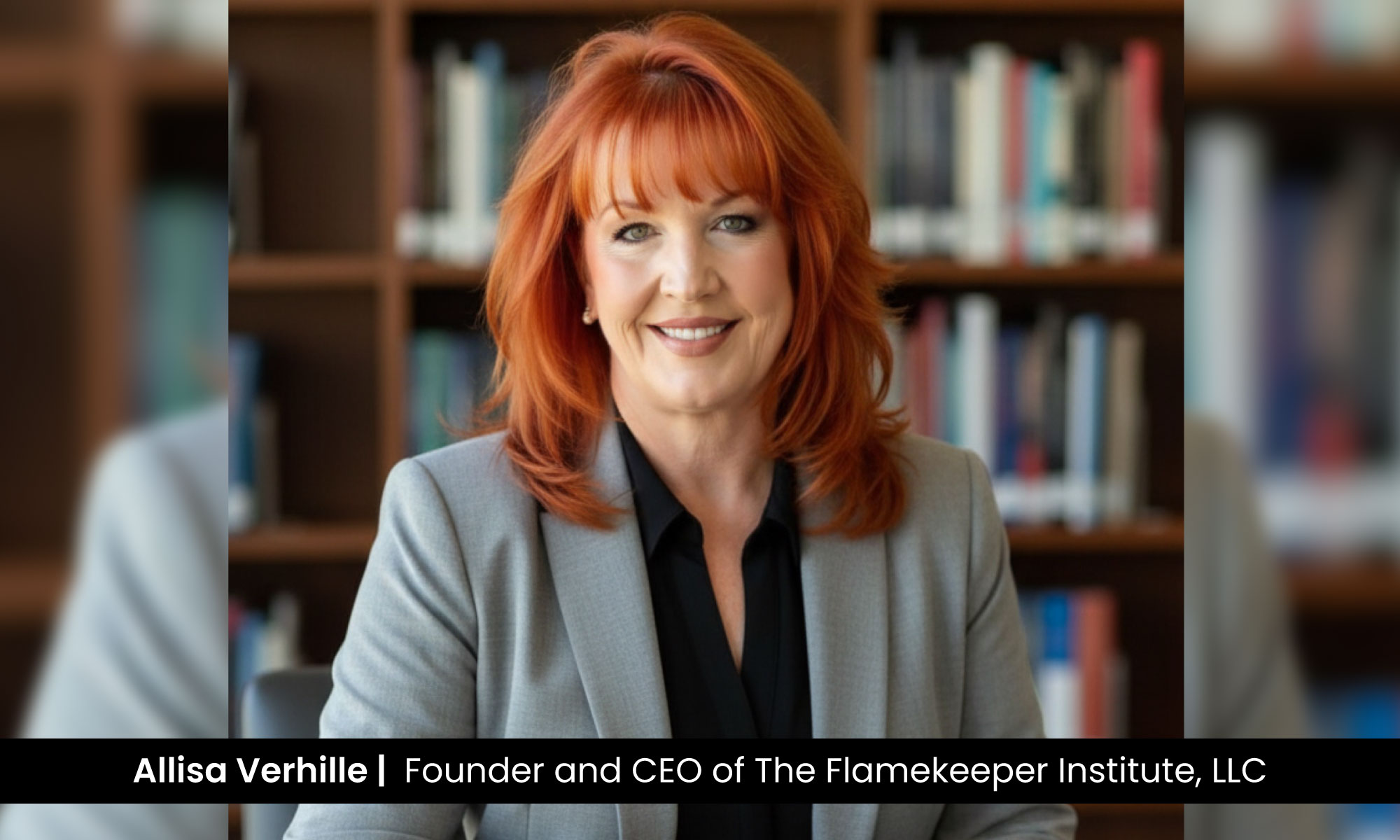
What if one conversation could change the way a leader sees their business, their team, and even themselves? What if a single question could turn an ordinary day into a turning point not just for one person, but for everyone whose life they touch?
For Allisa Verhille, leadership has never been simply about making decisions, meeting expectations, or being the person everyone depends on. It is about understanding what happens beneath the surface: the responsibilities people carry, the decisions they struggle to release, and the identities they build around being needed by everyone else.
Through her work as the Founder and CEO of The Flamekeeper Institute, LLC, Allisa helps leaders navigate the complex space between professional success and personal fulfilment. Having led complex enterprise initiatives and experienced the weight of being the person others count on to get things done, she understands that the qualities that make someone indispensable can sometimes become the very things that hold them and their teams back. Her approach begins with asking better questions. Who really needs to make this decision? What would help others take ownership? Is a team genuinely empowered to grow, or is it still waiting for permission? And when a leader has spent years defining their worth through what others need from them, who are they when nobody needs anything at all?
These questions reach far beyond the boardroom. They touch the quiet exhaustion of always being responsible, the courage required to trust others, and the difficult process of discovering who we are beyond our roles.
As an executive leadership coach and international bestselling author, Allisa creates space for reflection, meaningful conversations, and the kind of change that begins with honest self-awareness. She recognises that sustainable leadership is not about carrying every burden alone; it is about building people, strengthening systems, and creating room for others to rise. Her journey is a reminder that making a difference does not always require a grand gesture. Sometimes, it begins with one thoughtful question, one decision to let go, or one moment of quiet reflection.
Because when a leader learns to lead differently, the impact travels further than they can see. A team gains confidence. A colleague discovers their potential. A business finds a healthier way forward. And an ordinary day becomes different for everyone touched by that change. For Allisa, the real measure of leadership may not be how many people depend on you, but how many people become stronger because of you.
“The true measure of leadership is not how many people depend on you. It is how many people become stronger because of you.”
Reconnecting Success, Identity, and the Person Behind the Title
For Allisa, flamekeeping begins with seeing the person behind the title. She believes in understanding how leaders are truly doing, what they want from life, and whether they have had the space to reflect on these questions amid their responsibilities.
With more than 25 years of experience working in and around leadership, Allisa has led complex enterprise initiatives and been the person others relied on to get things done. While she takes pride in these accomplishments, she also recognises how being capable and dependable can gradually become intertwined with one’s sense of self-worth.
Through flamekeeping, Allisa helps leaders recognise these patterns and reconnect with themselves. Her approach also examines the organisational structures and expectations that contribute to exhaustion. She believes in ambition and encourages people to accomplish extraordinary things, but challenges the idea that exhaustion should be treated as proof of commitment. Rather than simply asking individuals to become more resilient, she encourages organisations to examine why so much resilience is required in the first place.
Her process begins with listening. When a leader approaches her with a business challenge, she takes the concern seriously while paying attention to the deeper patterns that emerge during the conversation the responsibilities they continually assume, the difficult conversations they postpone, and the beliefs influencing their decisions. For instance, a leader frustrated by a team’s lack of initiative may also be requiring approval for every decision. Allisa explores what makes delegation difficult and what the leader needs in order to trust others with greater responsibility.
Through the Executive Identity Compass™, she helps leaders examine who they aspire to be and how their everyday choices are shaping that identity. Her approach combines empathy with the courage to ask uncomfortable questions, creating a safe environment where individuals can recognise their own patterns, reflect honestly, and decide how they want to move forward.
For Allisa, meaningful leadership development is not simply about solving business problems or improving performance. It is about helping people understand themselves, build healthier relationships with their responsibilities, and create professional success that remains connected to a fulfilling life.
Building Businesses That Thrive Beyond One Person
Allisa believes that one of the most important transitions for a founder is learning to build a business that can succeed without requiring their constant intervention. Having invested their time, energy, and identity into creating an enterprise, founders often find it difficult to let go of control. They may have spent years securing clients, solving problems, managing financial pressures, and making critical decisions. For them, stepping back can feel less like progress and more like a risk.
However, Allisa emphasises that sustainable growth requires founders to evolve from being involved in every decision to becoming leaders who empower others. One of the questions she uses to encourage reflection is, “If you stepped away for thirty days, where would the business struggle?” The answer can reveal where decisions, knowledge, and relationships remain too dependent on a single individual.
Through The Flamekeeper Institute’s Organizational Architecture™, she helps founders identify which decisions can be delegated, what support others need to take ownership, and which responsibilities the founder continues to hold unnecessarily. She also recognises the identity challenges behind delegation. A founder may genuinely want a capable team yet feel uncomfortable when that team no longer requires approval for every action. For Allisa, the goal is to help founders experience the satisfaction of building an organisation that can stand independently, giving them the freedom to focus on the business’s future while helping others grow into leadership.
Her approach is shaped by extensive enterprise experience, including leading the Walmart Ariba enablement initiative, which was delivered ten weeks ahead of schedule. While she takes pride in this achievement, she believes successful execution must go hand in hand with understanding the people responsible for delivering results.
When progress stalls, Allisa prioritises understanding the underlying circumstances before deciding how to respond. Someone waiting for a decision needs timely support, while someone who has the necessary resources but is not following through may require a different conversation. She believes that treating these situations identically can discourage team members from communicating honestly about challenges.
Through her advisory work and Leadership Intensives, she encourages a culture of transparency, accountability, and mutual respect. She wants people to raise concerns while there is still time to address them, identify risks early, and make realistic commitments. For Allisa, genuine care does not mean avoiding difficult conversations; it means being honest about expectations while ensuring people can communicate without fear of humiliation.
Ultimately, her philosophy brings together human understanding and organisational effectiveness. She believes leaders can build stronger businesses by creating systems that reduce dependency, teams that take ownership, and workplaces where accountability and dignity coexist.
“Being indispensable may have built your career. But it should never cost you your identity.”
Turning Organisational Change into Measurable, Lasting Impact
Allisa believes that successful transformation begins with understanding why people may be hesitant to embrace change. Before asking employees to support another organisational initiative, she seeks to understand their experiences with previous transformations. Were their suggestions ignored? Did new processes make their work more difficult? Did leadership introduce new expectations while continuing to reward old behaviours? For Allisa, resistance is not necessarily a lack of commitment; it may reflect legitimate concerns that leadership has yet to address.
Transparency and follow-through are central to her approach. Allisa believes employees deserve clarity about which decisions they can influence and honest explanations of how their feedback has been used. Announcing a new initiative is not enough; leaders must demonstrate through consistent actions that this time will be different.
Her perspective is grounded in practical business experience, including involvement in an integration initiative that generated approximately $12.6 million in savings. This experience reinforces her belief that organisational improvement must be supported by clear objectives, measurable outcomes, and a realistic understanding of existing challenges.
To assess progress, Allisa encourages leaders to establish a clear picture of current performance before introducing changes. Whether decisions are taking too long, talented employees are leaving, or executives remain involved in every escalation, the underlying causes must be understood before meaningful improvements can be made. Progress can then be evaluated through tangible indicators, such as faster decision-making, reduced rework, earlier identification of problems, improved accountability, and greater independence among teams.
However, she believes success extends beyond financial performance and operational efficiency. It also includes whether leaders have more time to think strategically, delegate with confidence, and step away from daily operations without the organisation struggling in their absence.
Allisa takes a measured approach to evaluating impact, recognising that organisational outcomes are shaped by many factors. Rather than attributing every improvement to coaching or advisory work, she emphasises the importance of identifying what changed, understanding how those changes occurred, and demonstrating how her work contributed to the results.
For her, meaningful transformation is not defined by the announcement of a new strategy but by the lasting changes people experience in their everyday work. It is about building organisations where employees feel heard, leaders act with consistency, and progress can be seen not only in business results but also in how effectively people work together.
Mission to Transform Lives Through Authentic Stories, Self-Discovery, and Meaningful Connection
Allisa is driven by a desire to reach more people while preserving the personal connection that lies at the heart of her work. She understands that executives navigating difficult transitions need more than professional advice; they need a safe space to speak honestly about their circumstances, explore their experiences, and feel genuinely heard. Through executive advisory services and Leadership Intensives offered by The Flamekeeper Institute, LLC, she works closely with individuals and organisations to help them navigate change with greater clarity and self-awareness.
Her exploration of Identity Exhaustion™ often begins with a simple but revealing question: “If no one needed anything from you today, how would you feel about yourself?” For some, the question creates a moment of pause, opening the door to feelings and patterns they may have struggled to articulate.
Beyond individual coaching, Allisa extends these conversations through her books, speaking engagements, and The Pressure Room™ podcast. Across these platforms, she aims to create the feeling of an honest, thoughtful conversation between two people—one sharing hard-earned lessons and the other discovering how those insights connect with their own life.
Ultimately, Allisa’s mission is not simply to introduce people to new concepts but to help them recognise themselves in the stories, understand the experiences behind their struggles, and identify practical steps towards change. By combining lived experience, reflective frameworks, and meaningful dialogue, she seeks to make leadership and personal growth more human, accessible, and relevant to everyday life.
“Before asking people to become more resilient, we need to ask why our organizations require so much resilience in the first place.”
Turning Leadership Insights into Meaningful Action
Allisa believes that effective leadership support is especially important when executives face difficult situations that shake their confidence and challenge their judgment. In such moments, her approach focuses on helping leaders regain clarity, assess the situation objectively, and respond with purpose rather than allowing fear or uncertainty to dictate their decisions.
As the situation develops, Allisa helps establish clear decision-making responsibilities and determine what information needs to be communicated. She encourages leaders to be transparent about what is known without making promises they cannot support. Through Pressure Intelligence™, she helps them recognise how emotional reactions, such as overexplaining, withdrawing, or attempting to take every responsibility back into their own hands, can influence their judgment and leadership effectiveness. By the second day, the focus shifts towards reviewing the response, assessing new developments, and adjusting the next steps as required.
Throughout this process, Allisa reinforces an important distinction: a difficult event demands accountability, but it does not define a person’s entire identity. She believes leaders must be able to acknowledge what has happened, take responsibility for their decisions, and move forward without allowing one challenging experience to overshadow their broader capabilities and contributions.
Consistency is equally important to her. She wants the Institute’s proprietary frameworks, including the Flame Spiral™ Remember, Release, Reclaim, Rise, and Illuminate to remain recognisable across books, articles, and personal interactions. Each platform should reinforce the same underlying principles while offering practical ways to apply them.
Allisa also sees real-world conversations as an opportunity to strengthen her writing. The questions and challenges that emerge during Leadership Intensives help her identify where explanations need greater clarity or where an idea requires a more practical application. By continually connecting written insights with lived experiences, she aims to ensure that people who discover her work through an article encounter the same thoughtful, relevant, and actionable approach when they engage with the Institute directly.
Ultimately, her goal is to bridge the gap between understanding a leadership principle and applying it when it matters most. She wants people to return to their workplaces better equipped to navigate uncertainty, make difficult decisions, and lead with greater awareness, accountability, and confidence.
Balancing Wellbeing, Human Judgment, and the Future of AI
Allisa’ understanding of leadership has been shaped not only by decades of professional experience but also by deeply personal lessons about resilience, wellbeing, and the importance of recognising one’s limits. She has learned that the ability to carry significant responsibilities does not mean continually taking on more. Having navigated serious health challenges, she has developed a different perspective on time, priorities, and what it truly means to live and work well.
This awareness also influences how she serves her clients. Allisa prepares carefully for each engagement because she values their time and wants to approach every conversation with clarity, focus, and the attention required to understand what they are genuinely experiencing. She is equally intentional about the opportunities she accepts, recognising that even a worthwhile opportunity may not be the right commitment at a particular moment. For her, practising what she teaches means acknowledging her own limits and making deliberate choices rather than treating overextension as an unavoidable part of success.
Looking towards the future of leadership, Allisa believes that sound judgment will become increasingly important as technology makes information and answers more readily available. She emphasises that a convincing answer is not necessarily the right one, particularly when it is based on incomplete information or incorrect assumptions. Leaders must learn to question recommendations, consider whose perspectives may have been overlooked, and verify the information before acting.
In her view, artificial intelligence can help people reach answers faster, but it cannot remove their responsibility for the decisions they make or the people affected by them. The real challenge lies in combining technological capability with human discernment, ethical consideration, and contextual understanding.
Allisa also believes that effective leadership requires the ability to listen to disagreement. In environments where information moves rapidly and expectations continue to rise, leaders can easily mistake agreement for genuine understanding. She stresses the importance of creating workplaces where people feel safe enough to challenge assumptions, raise concerns, and point out what may be missing without fearing that their contributions will be dismissed.
Ultimately, Allisa’s philosophy brings together personal wellbeing, thoughtful leadership, and responsible technological advancement. She believes that learning to use new technologies is essential, but so is preserving the human qualities that make leadership meaningful: curiosity, empathy, sound judgment, and the willingness to question what appears obvious. For her, the future belongs not simply to those who can find answers quickly, but to those who can determine which answers deserve to be trusted and how their decisions will affect the lives of others.
“AI can accelerate the answer. It cannot replace the human judgment required to live with the consequences.”
Building Leaders and Organisations Where Success Doesn’t Come at the Cost of Wellbeing
Allisa envisions a future in which organisations rethink resilience not as the ability to endure ever-increasing pressure, but as the capacity to recognise and address the conditions that make that pressure unsustainable. She believes that before asking leaders to withstand more, organisations must examine why their roles continually demand so much from them.
She is also preparing to expand her reach through The Fire Within, planned for publication in early 2027. Through her writing and speaking engagements, she hopes to connect with people who recognise the experience of carrying too much responsibility but may not yet have the language or support to understand what they are going through.
At the heart of her approach is a commitment to clarity delivered with respect. When she sees a potential risk in a decision, she believes in acknowledging the intended outcome, explaining the concern honestly, and helping those responsible examine their options. For Allisa, agreement is not valuable if it leaves people exposed to risks that could have been addressed through an honest conversation.
She also believes that progress requires both thoughtful consideration and decisive action. Rather than attempting to resolve every cultural challenge before moving forward, she prioritises understanding the decision, ensuring that the people involved know why it matters, and clarifying what each person must take responsibility for. This allows organisations to move with purpose without confusing speed with superficial resolution.
Ultimately, Allisa’s mission is to help leaders recognise the difference between pressure that enables meaningful achievement and pressure that gradually diminishes them. She challenges the belief that personal value depends on being indispensable, encouraging individuals to build organisations where responsibility can be shared, people can flourish, and success does not come at the expense of wellbeing.
Her philosophy returns to three powerful ideas: Remember what truly matters, Reclaim the identity and agency that may have been lost beneath expectations, and Illuminate a more conscious path forward. For Allisa, lasting change begins when leaders understand themselves, question the systems around them, and choose to lead differently.

