
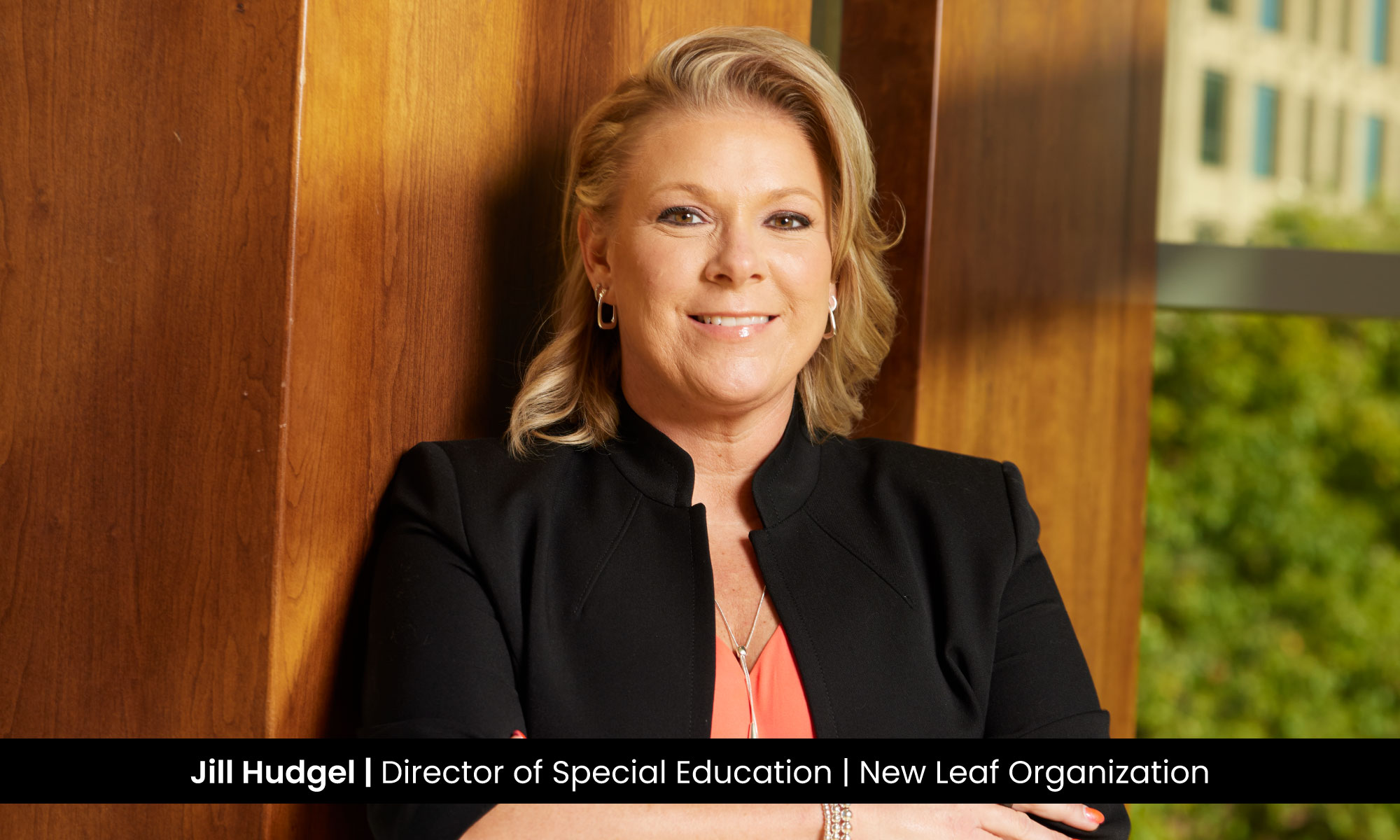
Jill Hudgel, Director of Special Education at New Leaf Organization, believes the future of education will be shaped not by systems alone, but by relationships. Known for her deeply relational leadership style, she has spent her career building trust with students, families, and educators while advancing inclusive, flexible approaches that meet learners where they are. Through collaboration, compassion, and a forward-thinking mindset, Hudgel is helping redefine what support and success look like in special education .Her work reflects a growing shift in leadership, one that prioritizes connection, adaptability, and community partnership as essential drivers of innovation.
Jill has witnessed firsthand that students’ responsibilities and challenges outside of school are more complex than ever. Academic success alone is no longer enough. Sustainable futures require connection to employers, to community agencies, to mental health providers, and to real-world experiences that build confidence and independence. That belief has shaped New Leaf’s programs that go beyond textbooks: automotive training, boutique services, greenhouses, and grow towers that allow students to explore entrepreneurship while gaining tangible, transferable skills.
Her leadership is rooted in compassion but driven by strategy. When schools can clearly see what is happening with each student academically, emotionally, and socially they are far less likely to lose them along the way. For Jill, success means creating environments where students feel supported not just until graduation, but long after it.
Through collaboration, compassion, a deep commitment to student advocacy, and a forward-thinking mindset, Jill is helping redefine what support and success look like in education ensuring that in a world that often moves too fast, no student is left unseen.
Leading with Visibility, Building Systems with Heart
One of the most important lessons Jill has carried throughout her career is the power of making students feel genuinely seen and valued. She believes every student enters the classroom with a unique story, set of beliefs, and lived experiences. By taking the time to understand their lives beyond school, she communicates a powerful message: they matter.
Early in her career, she taught in a school founded on religious principles, where those values were deeply woven into the educational model. Students’ cultural and personal identities were closely connected to their learning experiences. That environment showed her that when students feel respected for who they are, it creates space for authentic connection and stronger classroom outcomes. This belief continues to guide her leadership approach and shapes how she supports both students and educators at New Leaf.
A pivotal experience in her professional journey was leading a full state audit of a special education program early in her leadership career. At the time, she was working in a dropout prevention and credit recovery setting under the same executive leadership that now directs New Leaf’s mission and model. The audit required a thorough review of compliance practices, progress monitoring, service delivery, documentation, and record-keeping accuracy, an intense process that accelerated her growth as a leader.
Through this experience, she developed the skills to conduct internal audits, strengthen communication with staff and families, and implement systems that ensured students received the services they needed and deserved. What initially felt like an overwhelming challenge became a pivotal turning point. It reinforced her conviction that strong systems and meaningful relationships must operate together to create responsive, student-centered programs and to shape the future of inclusive education.
Redefining Equity Through Flexibility, Innovation, and Student-Centered Growth
Jill believes growth is born from challenge. True evolution, in her view, happens when individuals and institutions are willing to step beyond what feels comfortable. At New Leaf, that philosophy translates into questioning long-held assumptions about education and re-examining what students genuinely need in order to succeed.
The New Leaf approach centers on meeting students where they are and building individualized pathways that nurture both academic achievement and personal development. That same mindset guides how she works closely with educators, families, and special education coordinators to ensure that students receive the academic support and foundational resources they need to succeed. She encourages her staff to experiment with new strategies, collaborate openly, and engage in continuous reflection creating a culture where improvement is shared and ongoing.
She recognizes that traditional education systems often rely on a one-size-fits-all structure. Yet many students navigate responsibilities beyond the classroom, such as employment, parenthood, housing instability, and other life challenges that make rigid systems difficult to navigate.
At New Leaf, flexibility is viewed as equity. The organization offers extended hours, workplace learning opportunities, and personalized pathways that allow students to progress at a pace aligned with their circumstances. Partnerships with local employers ensure programs reflect real workforce needs and relevant skill development. By acknowledging students’ realities while maintaining meaningful, individualized standards, she is helping reshape education into a model that is both compassionate and accountable.
Beyond the Diploma: Building Purpose, Pathways, and Possibility
Jill believes that preparing students for life beyond graduation is essential to building sustainable futures. In her view, a diploma is not the final destination, it is the starting point. Integrating hands-on learning and meaningful career exploration into the educational experience ensures students understand the relevance of what they are learning and how it connects to their future goals.
Programs such as automotive and boutique services, along with greenhouses and grow towers, are intentionally designed to help students explore entrepreneurship while developing confidence and practical, real-world skills. These initiatives provide more than technical training; they cultivate purpose. That sense of purpose strengthens both student well-being and long-term success.
Technology also plays a strategic role in supporting student outcomes. Advanced computer systems allow her team to monitor progress in real time and identify potential concerns early. This visibility strengthens collaboration among staff and enables swift, targeted interventions when additional support is needed. When educators have a clear understanding of each student’s journey, they are far less likely to let anyone fall behind.
At the same time, she emphasizes that technology is a tool, not the foundation. Its greatest value lies in enhancing human connection. Data provides insight, but relationships remain at the heart of her work.
Leading with Purpose, Growing with Depth
Over the next 12 to 24 months, Jill envisions New Leaf growing not only in reach, but in depth. For her, growth is not measured solely by additional programs or new locations; it is defined by the strength and quality of support provided to students and families. From a special education perspective, that means continuing to refine systems that are flexible, individualized, and responsive to the whole child. She is focused on deepening partnerships with employers, community agencies, and mental health providers to ensure students have access to both academic pathways and life pathways that foster long-term stability and opportunity.
She anticipates continued expansion of innovative approaches that blend flexibility, personalized learning, and career readiness. Special education has always demanded creativity and adaptability to meet students exactly where they are and she believes that mindset is increasingly shaping the broader evolution of education. As student needs continue to change, schools must respond by creating environments where students feel seen, supported, and fully prepared for life beyond graduation.
Her advice to leaders entering the social impact space is clear: remain grounded in purpose, but stay adaptable. The landscape will continue to shift, yet the most effective leaders are those who listen first, build authentic relationships, and remain willing to rethink traditional models. When leaders focus on people rather than programs, uncertainty becomes an opportunity for meaningful innovation.
She also identifies humility as one of the most overlooked leadership traits. In mission-driven work, and especially in special education, leaders are constantly learning from students, families, and communities. Humility allows them to listen, adjust, and grow rather than assume they have all the answers. It fosters collaboration and builds trust in environments that are often complex and evolving.
At the same time, she believes humility must be balanced with confidence. Leaders need the courage to make difficult decisions and advocate for change, while also recognizing when fresh perspectives are necessary. In special education, where every student’s situation is unique, this balance is essential. When leaders model both humility and confidence, they create cultures where teams feel supported, innovation is encouraged, and the mission serving students remains at the heart of every decision.
Unwavering Commitment to Every Student’s Future
Jill often returns to a few guiding beliefs that shape her leadership and her approach to education. She believes that students engage in learning when they feel truly seen, valued, and supported. For her, flexibility is not about lowering expectations, it is about creating the conditions where every student has a real opportunity to succeed. She also emphasizes the importance of strong partnerships knowing that when schools, families, and communities work together, they open doors that extend far beyond graduation. Drawing from her experience in special education, Jill is committed to meeting students where they are and thinking creatively about how to support their growth. She believes this mindset is not only essential in special education, but is increasingly shaping the future of education for all learners. These aren’t just statements they are principles she lives by.
Her days begin early, grounded in intention. A morning workout and quiet reflection give her clarity and focus before the demands of the day begin. That routine allows her to show up fully for her family, for her students, and for her team.
She sees herself as trailblazing not for recognition, but for impact, willing to rethink structures, challenge assumptions, and build systems that better serve students. Influenced by frameworks such as Bridges Out of Poverty and the ACEs (Adverse Childhood Experiences) model, she developed a deeper understanding of trauma and its effects on learning. That perspective has profoundly shaped how she leads, supports staff, and designs student-centered systems.
At the heart of every decision, she asks one consistent question: What will have the greatest impact on students? By keeping students at the center, complexity becomes clearer, priorities sharpen, and leadership becomes purposeful.

