
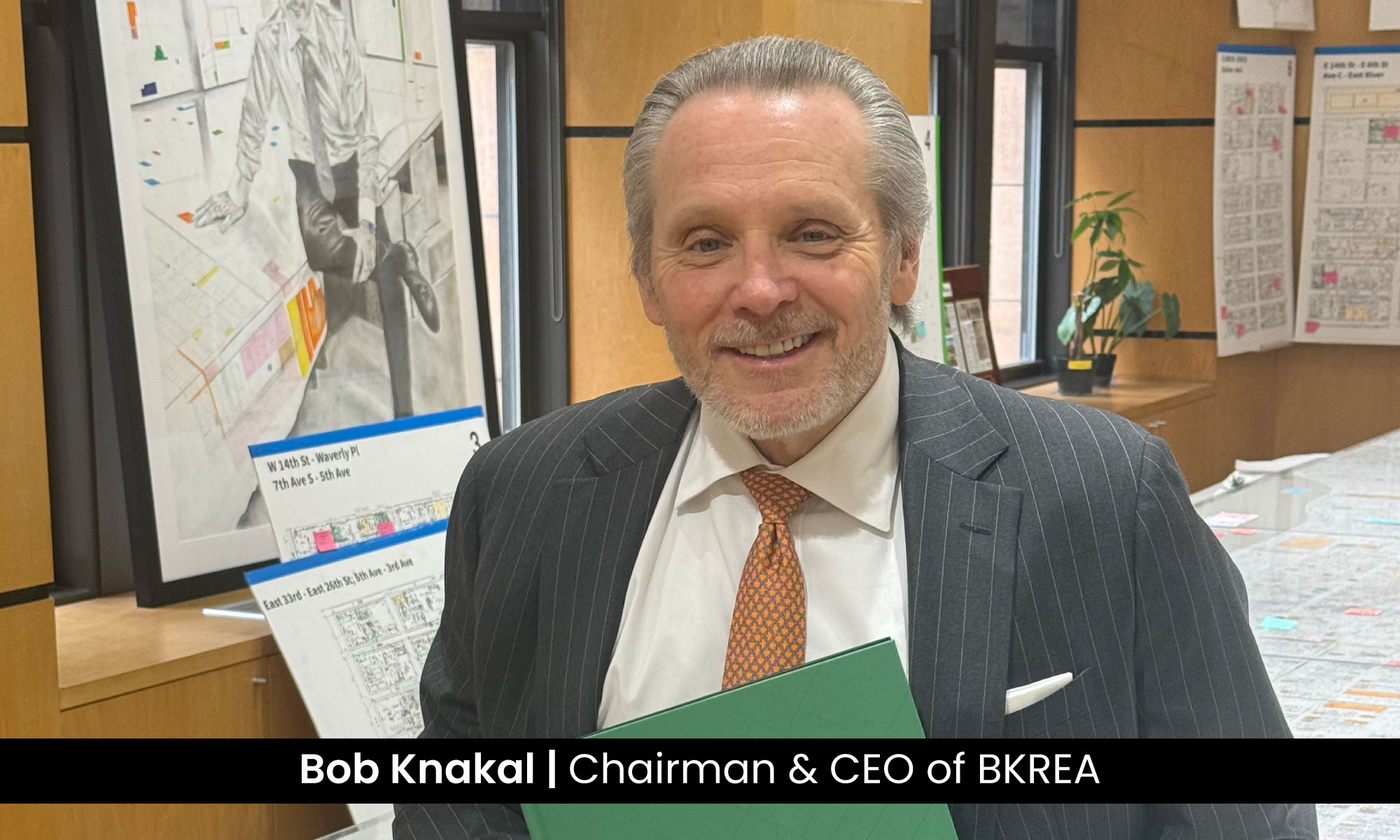
Some leaders don’t just follow markets, they understand cycles, people, and timing. They believe that doing the right thing for clients never goes out of style, and that excellence only comes from going all-in, every single time. Over decades, this philosophy has reshaped how relationships are built, how information is valued, and how firms grow from the inside out.
That mindset belongs to Bob Knakal, Chairman & CEO of BKREA, who is someone who transformed the old “mile wide, inch deep” approach into a focused, relationship-driven model rooted in trust, discipline, and long-term vision. Known for redefining how real estate advisory truly works, he emphasizes that the business is not about property alone, but about information, relationships, and understanding who the real buyers are in every cycle.
At the core of his leadership is a simple but powerful goal: to build an environment where professionals grow faster than anywhere else not because they are managed, but because they are supported, encouraged, and inspired to outperform even their own expectations.
From Accidental Beginnings to Enduring Leadership Across Every Market Cycle
One of the most enduring lessons Bob has carried on throughout his career is that doing the right thing for the client, never goes out of style, is always the correct course of action. His entry into real estate itself was unexpected. When he first encountered Coldwell Banker, he mistakenly assumed it was a bank. There was no master plan, no family legacy in the industry, and no predefined roadmap, only curiosity and a willingness to say yes before fully understanding where the path might lead. That accidental beginning shaped a core belief early on: success is not about having all the answers, but about asking better questions, listening intentionally, and committing fully once something worth building reveals itself.
From the very start, Bob embraced an “all-in” approach. He learned that if something is worth doing, it is worth doing well. That philosophy guided his journey from co-founding Massey Knakal in 1988 to launching BKREA in 2024. Focus has been a constant thread throughout. At Massey Knakal, the firm avoided being everything to everyone. Instead, it specialized relentlessly, built scalable systems, and fostered a culture where brokers were acknowledged, trained, inspired, and empowered to grow. At BKREA, the same principle remains but with even sharper intent and refinement.
Underlying this approach is Bob’s clear understanding that real estate is not merely about building; it is fundamentally an information and relationship business. Having the best information and protecting relationships is non-negotiable. Markets evolve, cycles shift, and participants change, but trusted relationships and disciplined insight endure.
One of the most defining chapters of Bob’s career came during the Global Financial Crisis. Fully negotiated deals suddenly became impossible to finance. Buyers vanished, capital structures collapsed, and uncertainty dominated the market. Yet, transactions still had to occur. That period crystallized a critical insight: liquidity is cyclical, but value, though volatile, is permanent. New York City has a unique resilience. Capital always returns, but it returns differently in each cycle.
This experience reinforced the importance of identifying who the real buyers are in every market phase, not who they were in the past. It also shaped Bob’s belief that the best brokers do not wait for markets to recover; they adapt faster than the market itself. That ability to adjust, refocus, and move decisively has defined his leadership across every cycle since.
Redefining How Brokers and Clients Win
For Bob, servant leadership is not a slogan; it is a daily discipline. Throughout his career, he has believed that brokers perform at their highest level when they feel genuinely seen, heard, and supported. At Massey Knakal, acknowledgment was never about empty praise; it was about recognizing effort, progress, and discipline. It was about building confidence, reinforcing self-belief and self-esteem, and creating an environment where individuals could consistently do better than their best.
That philosophy has evolved and sharpened at BKREA, adapted for a modern, entrepreneurial landscape. Today, Bob defines servant leadership as the act of removing friction. It means equipping brokers with superior data, advanced technology, effective marketing, and meaningful mentorship so their focus remains where it belongs: advising clients, not navigating broken systems. It also means encouraging specialization and intellectual honesty. When a broker doesn’t know an answer, the expectation is not perfect, but transparency and speed in finding the right solution.
The objective is clear and uncompromising: to build a firm where brokers grow faster than they could anywhere else, not because they are managed, but because they are supported, encouraged, and inspired to exceed their own expectations. Under Bob’s leadership, the traditional model of going a mile wide and an inch deep has been replaced with a more intentional approach, going an inch wide and a mile deep with clients, staying present at every step, and building relationships that endure beyond individual transactions.
Delivering Clarity Where Complexity Creates Opportunity
For Bob, the market gap was unmistakable. The development, redevelopment, and user-property sectors in New York City were consistently underserved by firms attempting to be all things to all people. At the same time, increasing government regulation around new development had created significant opacity in an environment where deep expertise could create real advantage. Bob saw an opportunity to go granular in a space where scale offered diminishing returns, and returning to his entrepreneurial roots became the natural next step.
While large brokerages excel at scale, Bob recognized that scale often comes at the expense of specialization and senior-level attention. BKREA was founded with a clear and deliberate focus: to concentrate exclusively on development, redevelopment, and user-building transactions in New York City. The firm is structured around professionals who are deeply embedded within specific verticals and submarkets, rather than spread thin across asset classes.
At the core of BKREA’s strategy are three highly correlated and synergistic verticals, all centered around vacant buildings. In New York City, every vacant building presents a fundamental question: do you demolish and build anew, renovate and convert the use, or sell to an end user who will occupy the property? BKREA spends most of its time answering that question with precision, insight, and execution.
The firm’s mission is simple but exacting: to deliver clarity in complexity. That means fewer listings, deeper analysis, and more thoughtful execution. BKREA does not chase volume, it pursues relevance and excellence. This distinction becomes especially critical in volatile or uncertain markets, where informed decision-making matters most. Where the industry once favored generalists, Bob has intentionally built a hyper-specialized platform. Supported by superior data and focused expertise, BKREA provides clients with advantages that were previously unattainable, enabling more informed decisions and consistently better outcomes.
Bob firmly believes that specialization transforms uncertainty into opportunity and that it remains the most effective way to differentiate in a competitive market. That differentiation, in turn, creates a durable competitive advantage.
Office-to-residential conversions exemplify this philosophy. These transactions are not theoretical exercises; they are highly technical, capital-intensive undertakings requiring zoning expertise, construction knowledge, capital markets insight, political awareness, and—particularly in New York City a granular understanding of the 467-M tax abatement program. A generalist, Bob contends, cannot effectively advise on assets of this complexity.
By focusing deeply on specific property types and geographies, BKREA can identify value where others see risk. The firm understands which buildings work, which do not, and most importantly, why. This depth allows BKREA to guide both buyers and sellers toward realistic pricing and executable strategies.
In today’s market, Bob is clear in his conviction: depth beats breadth.
Using Technology to See What Others Can’t
One clear example of Bob’s forward-looking approach is how BKREA analyzes buyer behavior and pricing sensitivity. While the firm continues to rely on timeless fundamental relationships, property tours, and direct conversations, advanced AI tools now allow BKREA to process thousands of historical transactions, zoning variables, financing structures, and buyer profiles simultaneously. This level of analysis reveals patterns that would be virtually impossible to identify manually.
When bringing a new asset to market, the firm can instantly review thousands of past records to understand precisely what percentage of the asking price each potential buyer has historically offered across prior transactions. This capability delivers a significant advantage to every new client. As a result, BKREA advises sellers not only on valuation, but on who is most likely to purchase the asset, at what price, and under which conditions.
Bob is clear that AI does not replace judgment, it sharpens it. By combining human insight with data-driven intelligence, BKREA remains well ahead of the curve in an industry undergoing rapid transformation.
At the same time, Bob is realistic about the structural challenges facing the market, particularly in conversion projects. The greatest hurdles remain cost, time, expertise, and regulatory uncertainty. Conversions are capital-intensive, financing structures are complex, and zoning approvals can be unpredictable.
In Bob’s view, the most effective solutions lie in targeted tax abatements, expedited approval processes, and zoning flexibility for buildings that meet clearly defined criteria. If New York City wants conversions to occur on a large scale, friction must be reduced and certainly increased. Capital, Bob emphasizes, moves quickly when rules are clear.
Lessons on Market Cycles, Decision-Making, and Staying Curious in Complex Times
According to Bob, today’s buyers are markedly more disciplined, more equity-focused, and significantly more patient than in prior cycles. Sellers, meanwhile, are increasingly bifurcated: those who must transact and those who can afford to wait. In evaluating any opportunity, Bob believes two factors matter most: how realistic a seller is relative to current market pricing, and how genuinely motivated that seller is. With no expectation of dramatic interest rate changes in the short to medium term, decisions must be grounded in present market realities rather than speculative assumptions.
The result is a market driven by necessity rather than exuberance. Transactions are occurring where motivation and realism intersect. While the pace may be slower, Bob views this as a healthy dynamic and one that, in many ways, has always defined durable markets.
He characterizes the current environment as transitional. Pricing is adjusting, capital is recalibrating, and opportunity is emerging quietly rather than loudly. Bob believes the last few years will ultimately be remembered as “the great pricing reset” in New York City. While most sectors are showing improvement, rent-stabilized housing continues to deteriorate, an outcome he attributes to political decisions rather than underlying market forces.
Bob’s advice is straightforward: do not wait for certainty, wait for alignment. When pricing, capital, and strategy align, action should be decisive. The best opportunities, he notes, are rarely obvious when they are created. In fact, Bob considers the current moment one of the strongest buying opportunities of the past four decades. In certain sectors, pricing per square foot has reverted to levels last seen thirty years ago, a rarity in New York City’s history.
Underlying Bob’s perspective is a deep commitment to intellectual humility and curiosity. He believes the New York market is far too complex for arrogance. The most effective brokers are confident but never complacent. They listen more than they speak, adapt faster than others, and remain lifelong students of the market. That mindset, constant improvement paired with curiosity about what else can be done better, is what sustains long-term success across cycles.

